


Summary
- Rafizi Ramli warns Penang’s limited land could become a long-term revenue challenge.
- State records show Penang’s revenue account came under pressure between 2020 and 2024.
- Penang expects RM1.068 billion in revenue and RM1.088 billion in spending for 2026.
- Non-tax revenue remains the state’s largest revenue source.
- Rafizi says Malaysia should review how revenue is shared between federal and state governments.
GEORGE TOWN, August 17 — Former economy minister Rafizi Ramli has warned that Penang’s limited land could put long-term pressure on state revenue, raising questions over whether Malaysia’s federal-state revenue system remains suitable today.
Speaking at a Bersama gathering in Penang, Rafizi said the problem would remain regardless of which party controls the state government. He argued that limited land could reduce Penang’s ability to generate income from land premiums in the future.

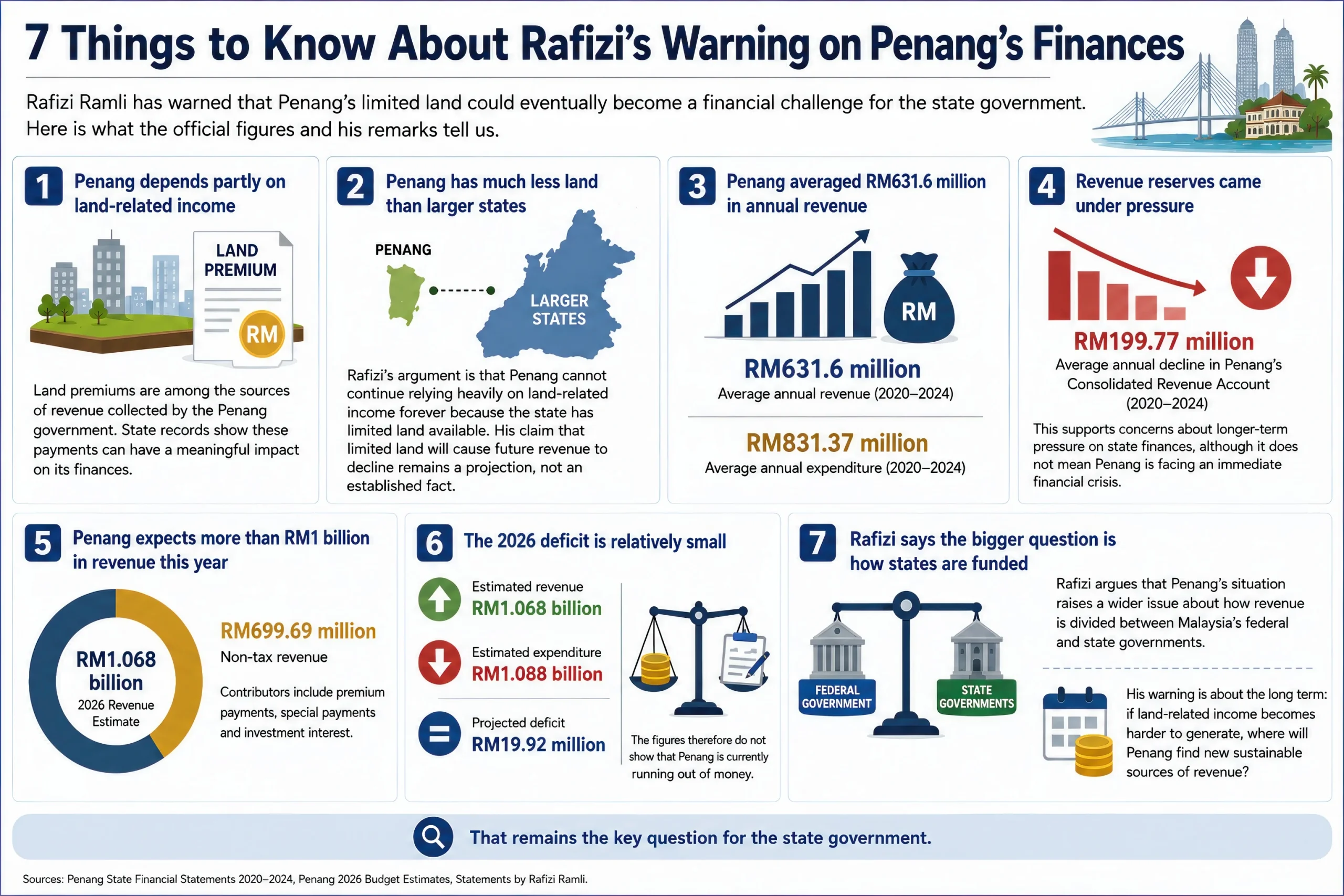
Official state figures show pressure on Penang’s finances in recent years. From 2020 to 2024, the state recorded average annual revenue of RM 631.6 million against average expenditure of RM 831.37 million.
Penang’s 2026 Budget projects RM 1.068 billion in revenue and RM 1.088 billion in expenditure, leaving a RM 19.92 million deficit.

Of the projected revenue, RM 699.69 million is non-tax revenue, with premium payments, special payments and investment interest among its contributors.
State records also show land premium payments can affect Penang’s finances. Some payments that were not initially expected in 2024 were eventually collected and helped improve the state’s revenue position.

Rafizi said the wider issue was whether the existing federal-state revenue model should be reviewed as states such as Penang face changing financial needs.
The latest figures do not show an immediate fiscal crisis. Rafizi’s warning instead focuses on whether Penang can maintain enough revenue over the longer term as its land becomes increasingly limited.