

Summary
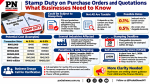
- Purchase orders (POs) and quotations containing binding payment obligations could be subject to stamp duty under the Stamp Act 1949.
- Official LHDN documentation confirms that stamp duty is assessed based on the contents of an instrument rather than its title.
- Business groups have raised concerns over additional operating costs, administrative burdens and potential retrospective penalties.
- Calls are mounting for the Ministry of Finance to clarify or exempt routine commercial documents from stamp duty.
KUALA LUMPUR, November 27 — Malaysian businesses are facing growing concerns over the potential imposition of stamp duty on purchase orders (POs) and quotations.
With industry representatives warning of increased operating costs and administrative burdens, particularly for small and medium enterprises (SMEs).
During a dialogue with business chambers on November 24, the Inland Revenue Board of Malaysia (LHDN) reportedly clarified that purchase orders and quotations containing transaction values.
And payment terms, including 30-day or 60-day credit arrangements, could be subject to stamp duty under Item 22(1)(a) of the First Schedule of the Stamp Act 1949.
Depending on their legal classification and applicable remissions, such instruments could attract stamp duty of up to 0.5% of the transaction value.
Legal Basis Under the Stamp Act 1949
According to LHDN’s official website, stamp duty is imposed on written instruments rather than the underlying transactions. LHDN states that commercial, legal and financial instruments listed.
Under the First Schedule of the Stamp Act 1949 are liable to stamp duty. These include instruments establishing contractual obligations for the payment of money.
In its official compilation of questions and answers from the October 14, 2025 taxation seminar, LHDN further clarified that stamp duty is determined by the substance of an instrument or agreement.
Rather than its title alone. LHDN also confirmed that service agreements fall under Item 22 of the First Schedule, with ad valorem duty assessed based on the contract value where applicable.
On October 6, 2026, LHDN announced the availability of technical guidelines concerning stamp duty on service agreements through its official portal.
However, not all purchase orders and quotations are automatically subject to stamp duty. Their contractual nature, payment obligations, applicable exemptions and remissions must be considered.
Potential Financial Impact on Businesses
Depending on the applicable classification, qualifying service agreements may benefit from a reduced effective stamp duty rate of 0.1%, while certain other chargeable instruments may attract a rate of 0.5%. The potential financial implications are illustrated below:
| Transaction Value | At 0.1% | At 0.5% |
|---|---|---|
| RM10,000 | RM10 | RM50 |
| RM50,000 | RM50 | RM250 |
| RM100,000 | RM100 | RM500 |
| RM500,000 | RM500 | RM2,500 |
| RM1 million | RM1,000 | RM5,000 |
| RM10 million | RM10,000 | RM50,000 |
For businesses issuing hundreds or thousands of purchase orders annually, the cumulative cost could be significant if those instruments are classified as chargeable.
Industries potentially affected include manufacturing, construction, logistics, wholesale, retail, advertising, media, technology and professional services.
Business Community Raises Concerns
The Associated Chinese Chambers of Commerce and Industry of Malaysia (ACCCIM) has reportedly raised objections over the interpretation and its potential implications for businesses.
Concerns include additional compliance costs, cash flow pressures, administrative workload and uncertainty surrounding historical commercial documents.
Parti Bersama Malaysia on November 26 also called on the Ministry of Finance to introduce a full exemption for purchase orders and quotations issued in the ordinary course of business.
The party further proposed a temporary suspension of enforcement and audits, protection against retrospective penalties and clearer guidelines on which commercial documents are subject to stamp duty.
Penalties for Late Stamping
According to LHDN, chargeable instruments executed in Malaysia must generally be stamped within 30 days. Under penalty rates effective from January 1, 2025, instruments stamped.
Within three months after the stipulated deadline may incur a penalty of RM50 or 10% of the deficient duty, whichever is higher. For delays exceeding three months.
The penalty increases to RM100 or 20% of the deficient duty, whichever is higher. These requirements could create additional compliance risks for businesses unaware that certain commercial documents, may fall within the scope of the Stamp Act.
Stamp Duty Self-Assessment System
Malaysia began implementing the Stamp Duty Self-Assessment System (STSDS) in phases on January 1, 2026. According to LHDN, taxpayers or their appointed agents are required to assess.
The applicable stamp duty, submit the relevant instruments, make payments and retain related records for seven years from the date of payment.
The system places greater responsibility on businesses to correctly identify and assess chargeable instruments.
Greater Clarity Needed
The issue raises questions about the relationship between stamp duty, Malaysia’s e-Invoicing implementation and the government’s broader efforts to digitalise business operations and reduce administrative burdens.
Further clarification from LHDN and the Ministry of Finance is needed to determine whether routine purchase orders, accepted quotations and documents issued under existing stamped master agreements require separate stamping.
While stamp duty remains an established component of Malaysia’s taxation framework, businesses are seeking greater certainty over its application to everyday commercial documentation.
A clear and consistent policy could help balance tax compliance and government revenue collection with business competitiveness, investment confidence and the sustainability of Malaysian SMEs.