


Summary
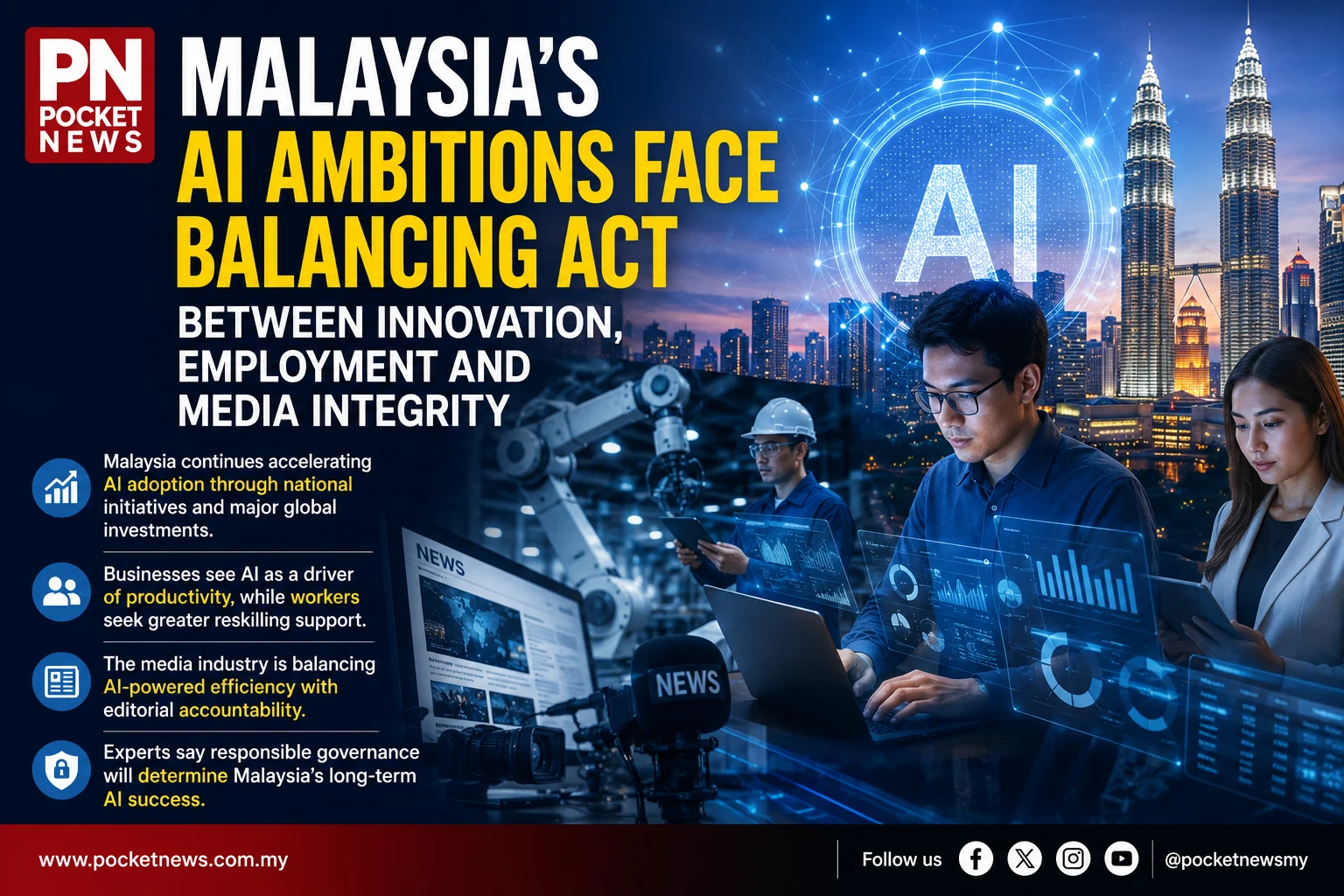
- Malaysia continues accelerating AI adoption through national initiatives and major global investments.
- Businesses see AI as a driver of productivity, while workers seek greater reskilling support.
- The media industry is balancing AI-powered efficiency with editorial accountability.
- Experts say responsible governance will determine Malaysia’s long-term AI success.
KUALA LUMPUR, June 29— Malaysia’s ambition to become a leading regional artificial intelligence (AI) hub is gaining momentum.
But industry leaders say the country now faces the challenge of balancing technological innovation with employment, regulation and public trust.
The government has accelerated AI adoption through national digital transformation initiatives, the establishment of the National AI Office (NAIO).
And investments in cloud computing, AI infrastructure and data centres. At the same time, policymakers continue to emphasise responsible AI governance.
Covering areas such as cybersecurity, misinformation, deepfakes, intellectual property, privacy and ethical use of AI. Across industries including manufacturing, healthcare, finance, logistics, education and customer service.
Organisations are increasingly deploying AI to automate repetitive tasks, analyse large datasets and improve operational efficiency.
While businesses generally view AI as a catalyst for productivity and economic growth, analysts believe the technology will reshape many existing roles.
Increasing demand for workforce reskilling and upskilling rather than simply replacing jobs. The media industry remains one of the sectors experiencing the fastest AI transformation.
News organisations are adopting AI for transcription, translation, audience analytics, content discovery and image enhancement to improve newsroom efficiency.
However, Communications Minister Fahmi Fadzil recently reaffirmed that AI should complement—not replace—professional journalists.
Speaking during the HAWANA 2026 celebrations, he rejected proposals suggesting AI-generated news could replace journalists.
Stressing that accurate reporting requires human judgement, editorial accountability, ethical decision-making and rigorous fact verification.
His remarks reinforced the principle of “No News Without Journalists.” Industry observers note that Malaysia’s greatest challenge is not whether AI should be embraced.
But how policies can simultaneously encourage innovation, protect employment, provide regulatory certainty and preserve public confidence.
As AI adoption accelerates, experts believe the country’s long-term competitiveness will depend on ensuring technology augments human capabilities.
While maintaining responsible governance and trusted institutions.