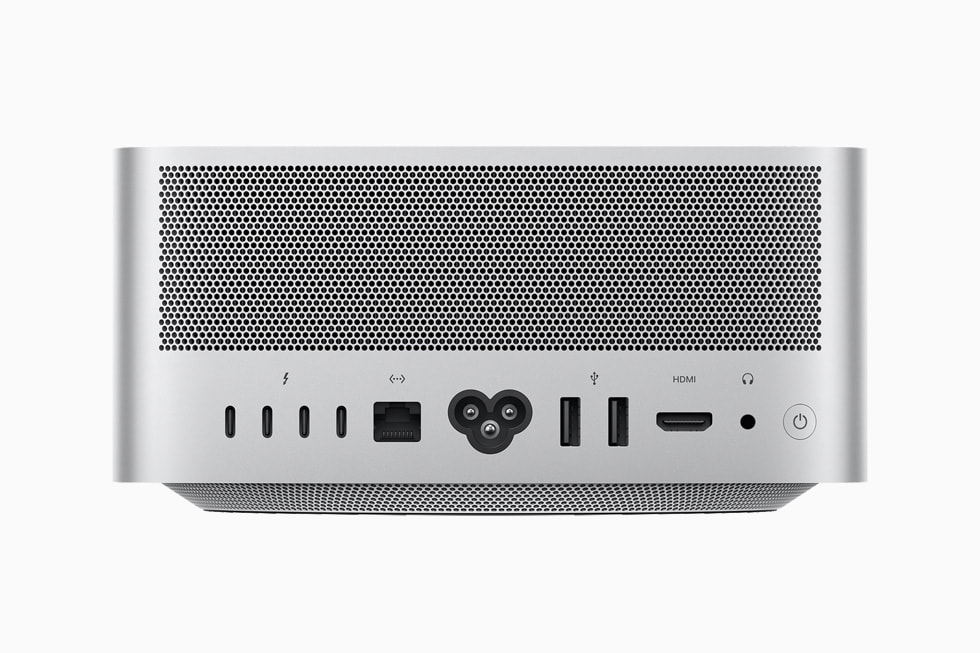



Apple’s Mac Studio has rapidly become a serious contender for artificial intelligence (AI) and machine learning (ML) workloads, driven by the capabilities of its M4 Max and M3 Ultra chips, massive unified memory, and an advanced Neural Engine.
With configurations supporting up to 512GB of unified memory and GPUs with as many as 80 cores, the Mac Studio can run large language models (LLMs) locally, dramatically reducing latency and power consumption compared to traditional GPU-based systems.
Its unified memory architecture allows the CPU, GPU, and Neural Engine to access a single high-bandwidth memory pool, making it especially efficient for AI inference, video processing, and 3D rendering.
A major leap comes from Thunderbolt 5 and macOS Tahoe 26.2, which introduce RDMA (Remote Direct Memory Access) over Thunderbolt, enabling multiple Mac Studios to be clustered together as if they share one enormous pool of memory.
Combined with Exo Labs’ open-source EXO 1.0 software, developers can now distribute AI workloads across several Macs, allowing trillion-parameter models to run locally at usable speeds. Tests of four linked Mac Studios with a combined 1.5TB of unified memory showed significant performance gains.
With memory access latency dropping below 50 microseconds and token generation reaching around 30 tokens per second on massive models. Beyond AI, the Mac Studio continues to excel in creative and scientific workloads, outperforming competing compact systems in benchmarks such as Geekbench and FP64 compute tests, while maintaining remarkably low power usage and near-silent operation.
A single M3 Ultra Mac Studio can rival or exceed the performance of small GPU clusters, making it attractive to researchers, developers, and creative professionals who want local compute power without relying on the cloud.
However, challenges remain. Managing clusters on macOS is still more cumbersome than on Linux, RDMA over Thunderbolt is new and occasionally unstable, and the lack of high-speed networking options like QSFP limits scalability beyond a handful of machines.
Even so, analysts say Apple has unexpectedly carved out a niche in local AI computing, positioning the Mac Studio as a compact, efficient “personal supercomputer” that could reshape how developers and creators approach on-device AI in the years ahead.