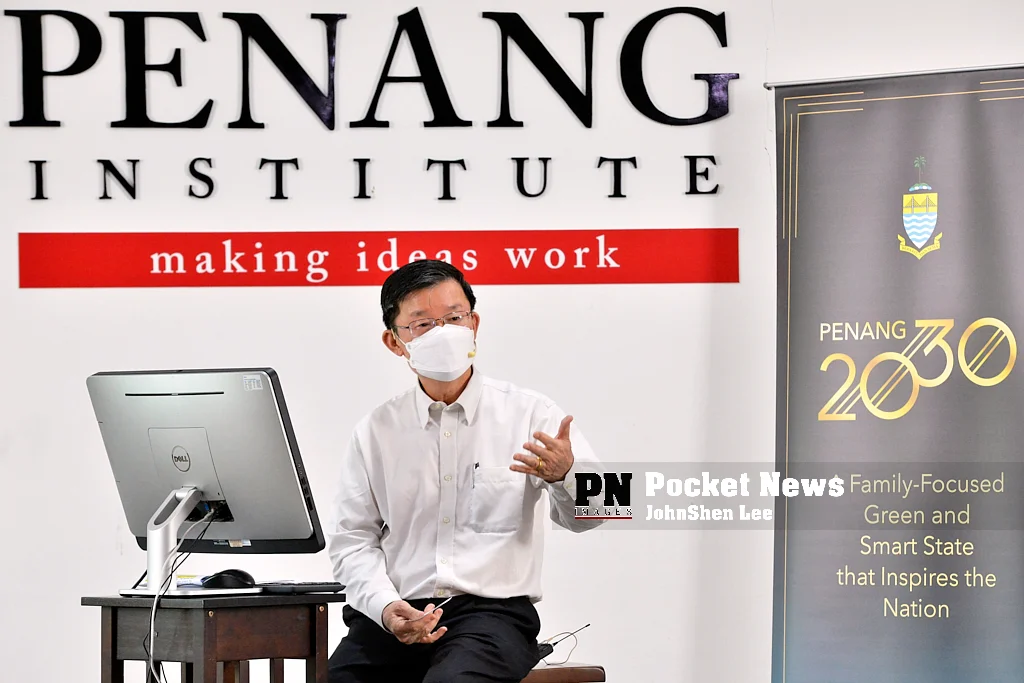


LONDON, Oct 18 – Penang Chief Minister Lim Guan Eng having a speech at TS Eliot Lecture Theatre at Merton College in Oxford University, England here on Wednesday. He said the last time he was here was on May 29, 2013, a few weeks after the 2013 general elections when he was hosted by the Oxford University Malaysia Club.
“This time, I have the honour of being hosted by the Blavatnik School of Government, Oxford University thanks to Datuk Seri Nazir Razak.Reading through the profile of this very new school in the hallowed halls of Oxford University, I cannot help but be amazed by its many accomplishments since its establishment in 2010,” said Penang Chief Minister Lim Guan Eng.
“In the three years since the first class of Masters in Public Policy (MPP) students were admitted in 2012, you have now grown to a cohort of 119 students from 55 countries for the class of 2015, including two Malaysians (Mark Hew and Yew Ren Chung),” he said.
“During this short period, you have also attracted a diverse group of world class researchers and scholars including Professor Sir Paul Collier, the author of the Bottom Billion; Professor Winnie Yip, director of the Global Health Policy Program here at Oxford and last but certainly not least, Professor and Dean Ngaire Woods, Dean of the school as well as an expert in the areas of global economic governance and global development,” he said.
“MPP students are no doubt interested in not just learning about public policy but also discerning for themselves the types of public policies which are effective in different contexts. I want to share with you some of my experiences as chief minister of Penang in the past seven years and in particular, some thoughts on how we put in place an “Entrepreneurial State” in order to achieve the status of a High Income economy through inclusive growth,” he said.
“Meanwhile, I shall also approach this from the angle of good governance with the dynamic smart economy that is sustainable and collaborative; social inclusion; talent building; liveability and the environment,” he said.
High-income hopes hobbled by the 30% depreciation in the ringgit
A short introduction of Penang, the second smallest state in Malaysia with a land size of only 1,048 square kilometres and a population of 1.7 million people, with no natural resources but has progressed to achieve high-income economy status through good governance, rule of law, integrity in leadership and sheer human talent.
The World Economic Forum Human Capital Report defined a high-income economy as one whose Gross Domestic Product or GDP per capita reaches USD$12,467 or RM 40,841 based on the then exchange rate of RM3.27 for USD$1 in 2014. Penang was expected to achieve a GDP per capita of RM42,251 based on a population of 1,681,922 people and a GDP of RM71,063 million by this year 2015. Penang’s GDP per capita of RM42,251 would have exceeded the benchmark of RM40,841 to become a high-income economy.
However, Lim said he wish to lay an important caveat that the precipitous drop in the value of the ringgit due to extraneous factors such as the 1MDB RM42 billion financial scandals on world currency markets, makes Penang technically not a high-income economy this year.
Instead of RM40,841 as the benchmark to achieve high-income status, the drop in the ringgit means that the benchmark has been increased to RM50,000. Of course should the value of the ringgit recover, hopefully by next year when all the political and financial scandals are resolved, then Penang can be restored to our rightful status as a high-income economy.
Business of government is not to get into business
“The term “entrepreneurial state” is associated with Mariana Mazzucato, and she is now one of the key economic advisers to the newly elected leader of the Labour Party, Jeremy Corbyn together with other economic heavyweights including Nobel Prize Winner, Joe Stiglitz; Thomas Piketty; and your very own Professor Simon Wren-Lewis, a faculty member at the Blavatnik School of Government,” said Lim.
“Her primary argument is for a wealth-creating agenda based on collaboration amongst “wealth-creators” involving not just business but also workers, public institutions, and civil-society organisations. Mazzucato makes a strong proposition that the state can lead the way in investing in risky areas especially in research and development, innovation as well as retraining and upskilling, which the private sector would not touch,” he said.
“This is a strong counterpoint to the current mainstream thinking that those who govern best govern least and let the private sector do its job. In Penang, we are shaping a progressive economic policy that is investment-led, inclusive, and sustainable to create wealth through a public-private partnership that drives long-term growth and productivity,” he said.
Besides that, in many respects Penang is an entrepreneurial state except that we do not believe in becoming involved in market outcomes, especially competing with business in accordance with our mantra of “the business of government is not to get into business”.
“In Penang as an entrepreneurial state, we see ourselves providing a catalytic role in providing public goods and services, basic communications infrastructure and spurring the development of key risky industries. But in other areas, especially where the private sector has a proven track record, the role of the government is to reinvent government and leave business to the private sector,” Lim added.
Benefits of reinventing government
“Let me illustrate this with an example which may surprise some of you. Many of you who have visited Penang or are familiar with Penang would associate Penang with a number of things – a rich, diverse culture and peoples; a thriving electronics and electrical (E&E) industry; and of course, our wonderful food. But very few of you would think of fish farming when you think of Penang,” said Lim.
“It would surprise you to learn that this industry grew from basically nothing in 2008 to a RM1.2 billion ringgit industry seven years later! Much as I would love to claim credit, this amazing transformation was done without spending a single penny but merely dependant on reinventing government,” he said.
In the same time, the previous government benefitted its cronies with one or two chosen individuals being given thousands of hectares of sea, which they then sub-let to genuine operators under the classic rentier system. This is described by some as predatory capitalism.
“We stopped this crony capitalistic practice and gave permits only to owner-operated fish farms up to a maximum of 8,000 square meters each. Rental was fixed at RM3,600 annually. Furthermore, we instituted a check list system where approval must be given if all the boxes were ticked. And the outcome of approval must be given within three months. This is how a billion ringgit fish farm industry was born out of nothing at all,” said Lim.
In additional, he added that this wasn’t rocket science at work which this is just putting into practice to the principle of CAT governance combining of the “Competency, Accountability and Transparency”, which was introduced immediately upon taking office.
We merely enabled the fish farming industry by giving the licenses to genuine owner operators, we empowered them by making the permit approval process much more transparent and the result was the enrichment of these firm farm operators and their employees as well as the state government!
Training human talent to avoid unemployable graduates
“Of course, Penang is much more than just fish farms. We are Malaysia’s most industrialised state with more than 95% of our GDP derived from manufacturing and services. Even though we are a small state making up only 5.5% of Malaysia’s population and less than 0.5% of its land mass, we punch above our weight by contributing 7.4% to the nation’s GDP, 7% of the total port container traffic and 12.3% of foreign tourist arrivals,” said Lim.
“Penang also contributes about 22% of Malaysia’s balance of trade surplus in 2014. Our economic growth rate is expected to be 6.2% this year despite the travails of the present economic climate. Penang has long been part of the network of global cities. We were established in the 18th century as a trading port by the British and prospered initially through trading spices, then rubber and tin. We are an open economy and a favourite destination for foreign investors,” he said.
From 2008 to 2014, we managed to achieve RM48.2 billion worth of investments, which is 93% higher than the RM24.9 billion (3.8 billion pounds) invested from 2001 to 2007. Penang’s economy also consistently outperforms Malaysia when the global economy is growing and is supposed. With over four decades of electronics products industrial experience, Penang is the most industrialised state in Malaysia and have been labelled the “Silicon Valley of the East”.
“We are also the main medical tourism hub in Malaysia and houses the regional headquarters for B Braun, the German medical device company. One of the reasons why we are able to punch above our weight is our human capital. They are the key drivers for much of our economy especially in the services sector and also in the high value added manufacturing sector,” said Lim.
“But human capital is a highly scare resource. In Penang, our unemployment rate is running at a national historic low of 1.2%, despite a net migration rate, with worker shortages our main concern. Despite our low unemployment rate, the major employers in the state are constantly complaining about not having the workers with the right kinds of skills and aptitude – the issue of correct training to avoid the problem of unemployable graduates,” he said.
To address this issue, the government recently launched a sponsorship agreement together with the Penang Skills and Development Center (PSDC) to support a German Dual Vocational Training (GDVT) program in the state. He said he are sure many here are familiar with the German vocational training system which does on the job teaching and training in the factories, this is a truly unique program within the Malaysian education system.
Not only does the Penang state government come out with RM2 million to sponsor the fees of these students, they also obtain a monthly stipend of the minimum wage of RM900 from the participating companies. Indeed they are paid to study. This dual concept of learning while working, generated a world-class workforce in Germany.
He said By partially funding this training program, Penang want to demonstrate that a world class vocational program can be a proven path to high income and high value added jobs, especially in the manufacturing sector. Developing human capital does not only happen in university classroom or in the workspace. The best brains in the world needs to be stimulated, challenged and nurtured from the earliest stage.
“Meanwhile, we facilitated the creation of the Penang Science Cluster (PSC), a state government initiative in collaboration with the private sector, to establish Penang as a center of excellence for science and technology by creating a science-based culture to inspire and encourage innovative thinking especially among the younger generation,” said Lim.
The PSC is the main organiser of the annual Penang International Science Fair (PISF) held in a sports stadium, the largest science fair in Malaysia. Its successful work with kids teaching them robotics, is a testimony to the co-operation between the public and private sector as well as civil society.
The one big difference is that the state government after providing seed money and helping to lead the scientific initiative, will then withdraw and allow the private sector to sponsor and run it compatible with industry needs of the skill-sets and the type of technology required.
Through these unique partnerships and collaborations, a new generation of scientists and innovators also can be enabled, companies both large and small can be empowered to reach deep into the talent pool and students and employers can be enriched as a result.
The area of human capital development is one where the state can play an entrepreneurial role. Technical and vocational education and training (TVET) has been largely ignored by the private higher education sector because of the perception that it is unprofitable, that there is no market among fee paying students for these programs and that TVET is associated with poorly performing students.
Making policy ideas work
Ideas for good governance and progressive policies are not created by accident. While the inputs are needed from various stakeholders, practitioners, public officials, civil society agents and think tanks. Any progressive agenda only succeeds if the policy ideas work.
“We have established a state think-tank, Penang Institute headed by Dr Lim Kim Hwa from Cambridge University, that explores new ideas and how to make them work. We are also working with international organisations such as Aga Khan Trust for Culture, to introduce community based urban regeneration projects which have changed the landscape of George Town, a Unesco world heritage site,” said Lim.
Tourists throng the streets of George Town, soaking up the “unique architectural and cultural townscape without parallel anywhere in East and Southeast Asia” – the very reasons George Town was inscribed by Unesco. In this, the state government plays a role of enabling George Town heritage city by combining the ancient and the modern, heritage with science.
Tech starts-up want to operate in the heritage area in their belief that the unique atmosphere can help to inspire innovation and creativity. To give the tech start-ups an additional boost, the state government launched an accelerator programme known as @CAT at an elegant historic building within the George Town’s heritage enclave offering very low rates for coding classes, students and start up entrepreneurs to gain access to mentors and shared services.
@CAT hopes to accelerate tech start-ups by applying the three new fields of Big Data Analytics (BDA), cloud computing and Internet of Things. We spent RM20 million without expecting any returns but are confident that we can create new synergies in the future for new and existing industries.
Freedom works
In addition, the state government is also rejuvenating the historical central market of Sia Boey into be a Heritage Arts District with RM 100 million (15 million pounds) which will include a public art museum. Learning from the successful urban regeneration of Southbank in London, the aim of this project is to preserve and upgrade the heritage market and buildings but at the same time introduce artistic venues into the center of life in the city. Using art and culture as a catalytic economic driver is a first in Malaysia.
Lim said he believe that all these initiatives are important to provide an inclusive growth platform for those who are talented in this creative sector. No doubt Penang has such hidden talents as Jimmy Choo, the world renowned shoe designer, is a Penang boy. However whilst talent is universal, opportunity is not.
“We must try to match talent with opportunity. To succeed, a government must grant freedom. Not just freedom of expression but freedom of equal opportunity, freedom to be the best they want to be and realise their potential! Also freedom from undue interference from the government,” he said.
Freedom works in Penang and is one of the key elements how a small economy can harness the energy, expertise and entrepreneurship of our people. The only way to escape the middle-income trap is through innovation, investing in education and rules-based institutions. In Penang we have the 3Ts of establishing creative clusters with Talent, Technology and Tolerance of new ideas.
Social inclusion
The fast growing economy as Penang, the government must always be aware that there will inevitably be those who fall between the cracks and do not enjoy the full benefits of a competitive marketplace. As part of our plan to eliminate hardcore poverty, soon after taking office in 2008, the government has put in place an income top-up scheme that would give families whose total earnings are below the Poverty Line Income (PLI).
The earnings which below the Poverty Line Income (PLI) are RM790 per month a top-up payment of between RM100 to RM790 per month. In other words, if a household earns RM500 monthly, RM290 will be every month. With this one move, hardcore poverty has been effectively eliminated in the state.
“However, we are aware of the unintended consequence of cash handouts as it cultivates a dependency culture and most importantly it does not break the cycle of poverty. Therefore, my government is ending unconditional cash transfers and transitioning towards conditional cash transfers whereby those receiving aid from the State must also ensure their children are in good health, getting the right vaccinations, children attending schools and achieve improved school grades,” said Lim.
“To support the talented but needy students to pursue their dreams, we have also launched the RM40 million Penang Future Foundation Scholarship programme with a simple proviso that the scholar has to work in Penang. The work can be in the private as well as the public sector. This is the classic example of Penang state government’s belief in enabling and empowering talents,” he said.
“In addition to this, this may come across as a bit of a surprise to some of you but we also made rubbish collection as part of a strategy to provide decently paid jobs to those at the bottom 40% households. It has been often repeated in Malaysia that no citizen would want to work in 3D jobs that are dirty, difficult and dangerous such as rubbish collectors,” he said.
“But when we offered jobs at RM1300 per month (which is RM400 more than the minimum monthly wage of RM900) for the job of a rubbish collector, we have 10 times more applicants than the 2,500 positions available. And all these were Malaysian applicants, not foreigners,” Lim added.
“So instead of awarding contracts to private contractors who would then employ foreigners as rubbish collectors, we asked the Seberang Prai Municipal Council to take back these jobs from private contractors and offer them instead to locals by directly employing them at a higher salary,” said Lim.
“The plan worked and even though we are spending 40% more than before or extra RM30 million, but at least we can say that we are feeding 2,500 families rather than allowing the profits to be enjoyed by the private contractors. To have inclusive growth, we must also ensure sustainable growth to the environment. The state government has also promoted recycling and was the first state in Malaysia to ban the distribution and use of free plastic bags,” he said.
“As of 2014, Penang has already reached a recycling rate of 32.8% which is the highest in Malaysia. By 2020, we aim to achieve 40% recycling rate, which is twice the national target of 20%. We also intend to lay dedicated bicycle lanes throughout the state. In the meantime, our economic success, our liveability factors and our care to the society have attracted many to Penang. Similar to the UK, affordable housing in a land scarce place like Penang is in short supply,” he said.
“We have set aside a public fund of up to RM1 billion to build affordable housing in the state. And we are able to pay for these affordable housing scheme because we auctioned off a piece of land on Penang Island via an open tender to the highest bidder! Indeed, we are praised by the Auditor-General Malaysia and singled out by Transparency International for our transparent open tender government procurement system,” he said.
“We could afford many of these progressive schemes aimed at the bottom 40% only because we were able to improve government finances significantly. Our cash reserves have increased by 50% and our debt has been reduced by 90%, budget surpluses recorded annually since we took over the state government in 2008,” he added.
From 2008 to 2013, the total surpluses came up to RM453 million, from which we have spent RM287 million on social welfare programmes to help the needy and other vulnerable groups within the state. Penang State Government was spend up to 12% on the annual budget on these socially inclusive programs.
Further the low unemployment rate is translated to households in Penang enjoying household income growth of 7.6% annually between 2012 and 2014. As a result of these progressive policies, the Gini Coefficient has been reduced from 0.42 in 2009 to 0.37 in 2012, an improvement of 11% over 3 years. While Penang’s Gini coefficient is better than Malaysia’s rate of 0.42, while there were still have some ways to go before we reach the Scandanavian levels of income inequality.
Enabling, empowering and enriching the people
Penang has consistently been rated one of the most liveable cities in Asia – the 8th in Asia according to ECA International and of course the most liveable in Malaysia. While having the best street food in the world with also having a Unesco World Heritage site in George Town.
“We are committed to making Penang the first bicycle and green state in Malaysia en route to being the premier destination to invest, learn, work, play and eat.The present debt crisis have shown that income inequality can not be solved by free markets. Free markets are said to be better than the state in provision of goods and services except a pro-market ‘rule of law’,” said Lim.
However, investment public goods such as infrastructure, basic social services, research and development, innovative technologies can only be done by the “entrepreneurial” state, provided that the state exit at the earliest opportune moment to prevent undue interference.
“We are still learning to grapple about when to exit so as not to throw good money after bad or divert resources for other worthwhile ventures. In the short time which I have been given, I have tried to paint vignettes of how Penang’s development is based on certain principles that are based on good governance and transparent decision making which enables them with skills and education, empowers with rights and responsibilities and enriches the people by sharing in economic wealth,” he said.
“Whilst we are focused on providing a better life for our voters, we realise that we can only win the future by investing in education. Whilst embracing the challenges of globalisation, we will not shy away from preparing the young for the future as well as prepare the future for young,” he said.
“I hope that in the course of your MPP program, you will get a taste of what it’s like to be involved in public policy, perhaps via your summer internship programs, in a tangible manner. I would like to invite to see for yourself what we have done in Penang,” he added.